Layered Architecture, Explained Like a Restaurant: Routers, Services, and Repositories
Understand routers, services, and repositories through a restaurant analogy, with inventory examples covering FEFO, transactions, row locking, and exact arithmetic.
A backend is easier to trust when every part has a clear job. Routers handle the conversation, services make business decisions, and repositories read and write data.
Imagine two warehouse operators trying to sell the last bag of flour at the same time. A neatly organized folder structure will not save the inventory by itself. The application needs rules about who can act, which stock can be used, and which changes must succeed together.
That is where layered architecture becomes useful.
This beginner-friendly guide uses a restaurant analogy and an inventory API example to follow one stock-consumption request from arrival to commit. The examples and diagrams illustrate the design; they are not an independent audit of the current FMIS repository.
1. ELI5: run your API like a restaurant
You order a sandwich. The waiter takes your order, the chef decides how to prepare it, and the stockroom clerk retrieves the ingredients. Nobody needs to do everybody else's job.
| API part | Restaurant equivalent | Its job |
|---|---|---|
| Middleware | Door staff | Check identity and the required role before a protected handler runs. |
| Router / handler | Waiter | Read the HTTP request, call a service, and format the response. |
| Schema | Order form | Define and validate the shape of the input. |
| Service | Chef | Apply business rules and coordinate the complete operation. |
| Repository | Stockroom clerk | Execute database queries and map the results. |
| PostgreSQL | Inventory records | Store data and enforce database constraints. |
Figure 1 — How a request moves through the API
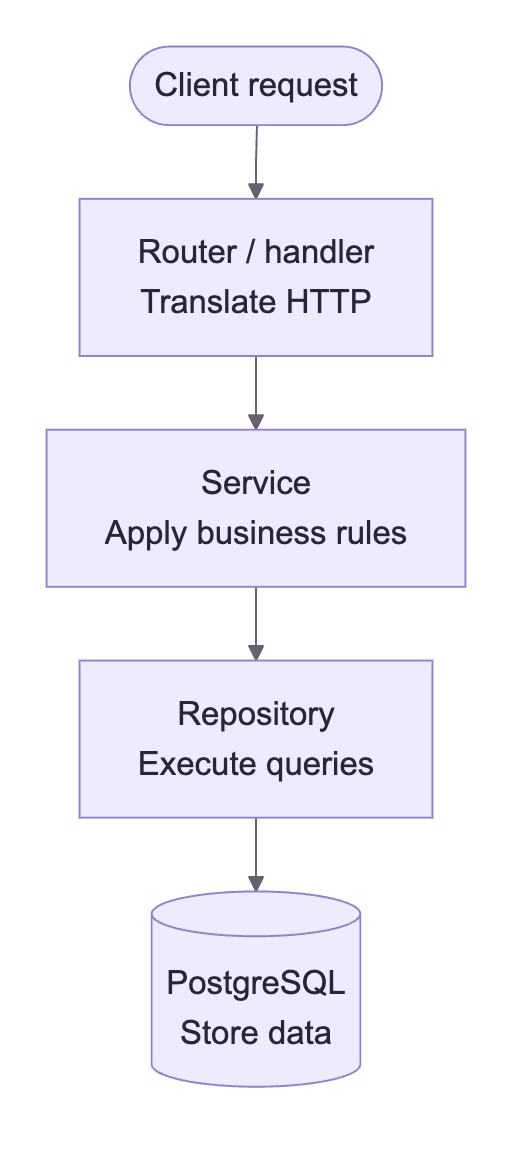
Read from top to bottom. The result travels back through the same steps to the user.
Think of a restaurant: the router is the waiter, the service is the chef, and the repository is the stockroom clerk.
The benefit is practical: when a rule changes, you know where to look. A service layer provides a boundary for application operations and coordinates their responses, including transactions. Service Layer — Martin Fowler
2. Routers translate; services decide; repositories execute
The router speaks HTTP
A router's handler answers technical questions: Which endpoint was called? Is the JSON readable? Which response status should be returned?
For an endpoint such as POST /api/v1/inventory/consume, the handler decodes a request, validates it, calls the inventory service, and returns the resulting ledger entries. It does not choose stock batches or write SQL.
ELI5: The waiter can tell you that your order form is incomplete. The chef decides whether the kitchen can actually prepare the order.
Schemas check the form, not the stockroom
A quantity such as "15.0000" can have the correct format while still exceeding available stock.
That distinction gives validation two homes:
- Schema validation: Is the product ID formatted correctly? Is the quantity positive and within the accepted precision and range?
- Service validation: Does the product exist? Are eligible batches available? Is there enough stock right now?
In this example, malformed input maps to 400, while insufficient stock maps to 409. Those mappings belong at the HTTP edge; the service reports a domain error such as ErrInsufficientStock.
The service owns the business operation
The service decides what must happen together. Consuming inventory means checking eligible stock, choosing allocations, changing balances, and recording movements.
It also decides when to start a transaction and when a locked read is required. The repository performs the actual SQL, including FOR UPDATE, using that transaction.
The repository owns data-access mechanics
The repository knows how to query batches and save a ledger entry. It receives values through query parameters and converts database rows into application data.
For FEFO, SQL supplies the expiration ordering; the service decides how much to take from each returned batch. This split keeps allocation policy testable without a database.
ELI5: The chef says, “Use ingredients that expire soonest.” The clerk retrieves the ordered list. The chef determines the amounts.
3. Follow a 15 kg request from start to finish
Assume an authorized operator requests 15 kg and the inventory contains enough eligible stock.
Figure 2 — The successful path and the exits that protect it
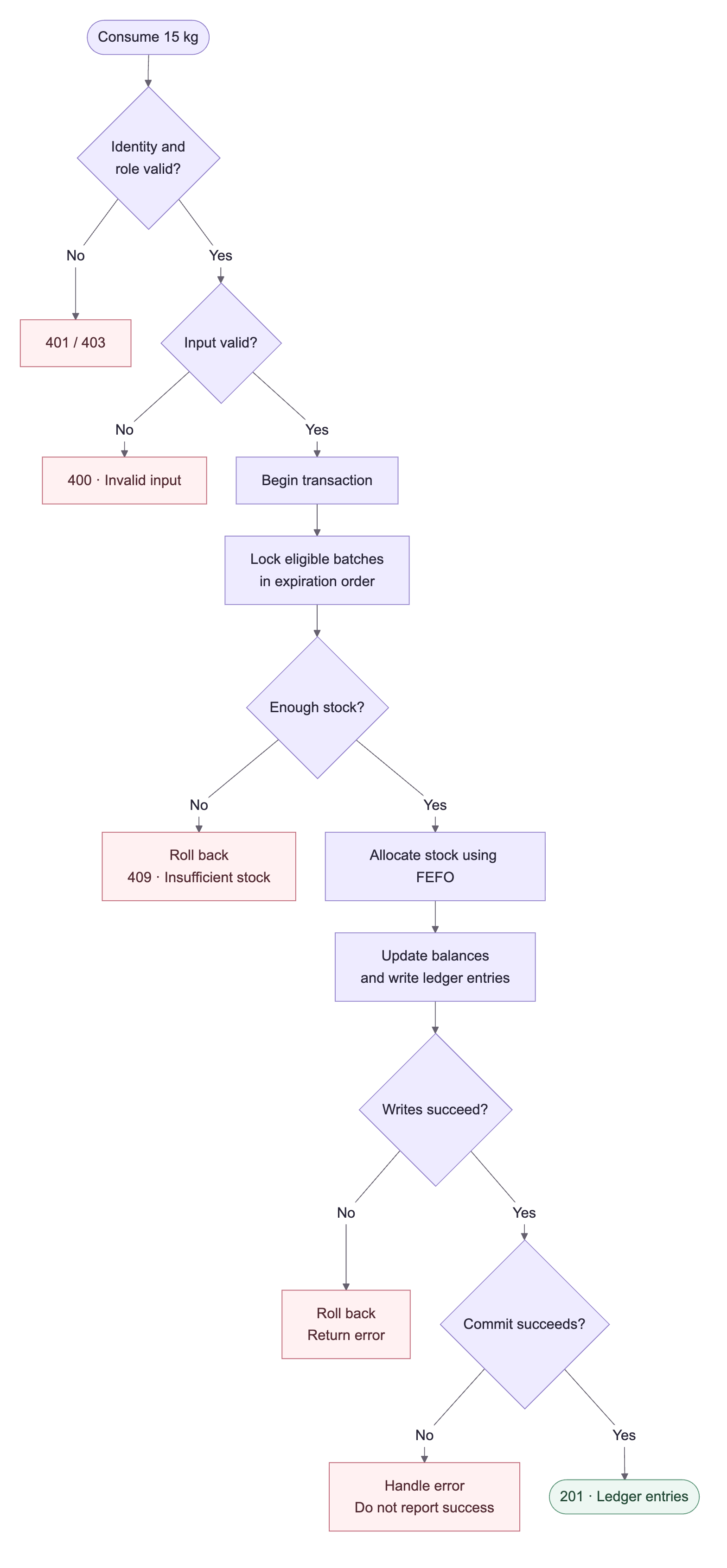
Database errors during the locked read also exit through the transaction error path. Error responses are translated by the router.
The key boundary encloses both the stock update and the audit record. Saving a lower balance without its ledger entry would leave the system unable to explain where the stock went.
ELI5: a transaction is an all-or-nothing order. Either the complete set of changes is saved, or the operation does not become a partial success.
With pgx's BeginFunc, a callback that returns an error triggers rollback; a nil callback error leads to a commit attempt. The caller must still handle the function's returned error. pgx transaction helper
A crucial implementation detail: check and return every write error. Ignoring a failed write can undermine the transaction's all-or-nothing behavior.
4. FEFO, explained with three bags of flour
FEFO means First-Expired, First-Out: consume the eligible batch with the earliest expiration date first.
Here is an illustrative allocation, assuming all three batches are eligible and have not expired:
Figure 3 — Filling a 15 kg request
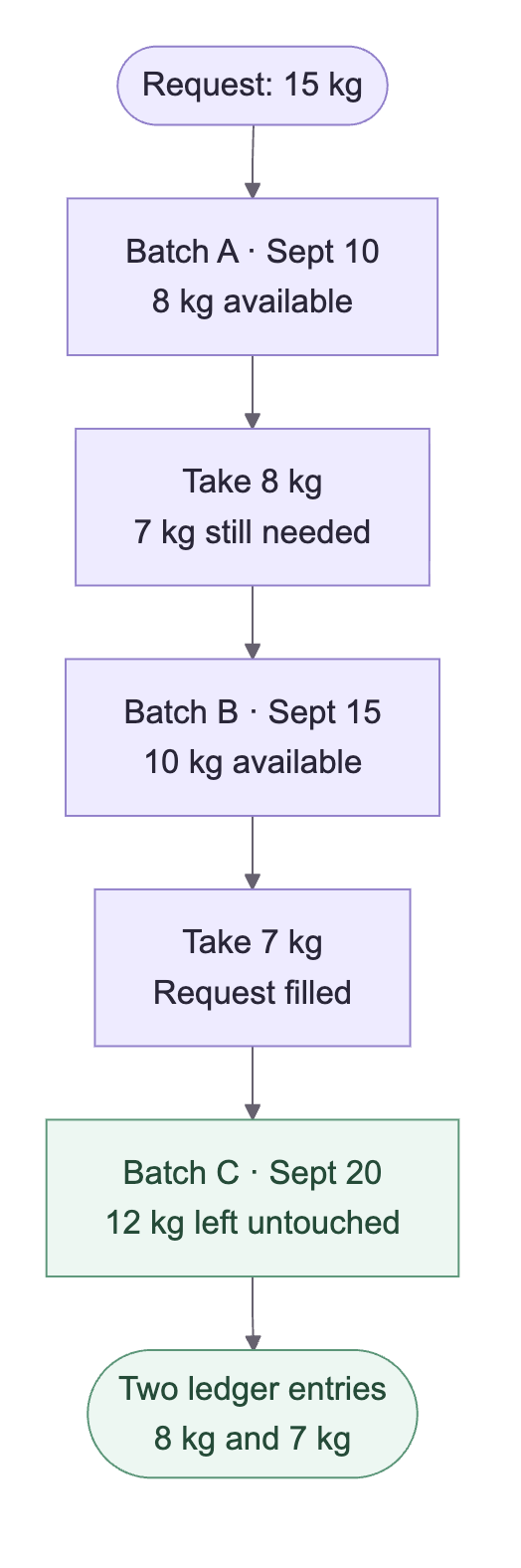
Afterward: A has 0 kg, B has 3 kg, and C still has 12 kg. Two outgoing ledger entries record deductions of 8 kg and 7 kg.
In this example, the repository orders batches with ORDER BY expiration_date ASC NULLS LAST. Batches without expiration dates therefore appear after dated batches. Eligibility is a separate rule: an expiration sort alone does not establish whether a batch may be consumed.
A pure selection function can return an allocation plan before any writes begin. Useful cases to test include an exact fit, a partial batch, several batches, empty stock, and an insufficient total.
ELI5: Finish the milk that expires tomorrow before opening the carton that expires next week.
5. Why two workers cannot both take the last stock
Suppose only 10 kg remains. Alice requests 7 kg; Bob requests 7 kg. If both make decisions from the same old balance, the application can approve 14 kg of consumption from only 10 kg.
Figure 4 — A locked read makes the second worker wait
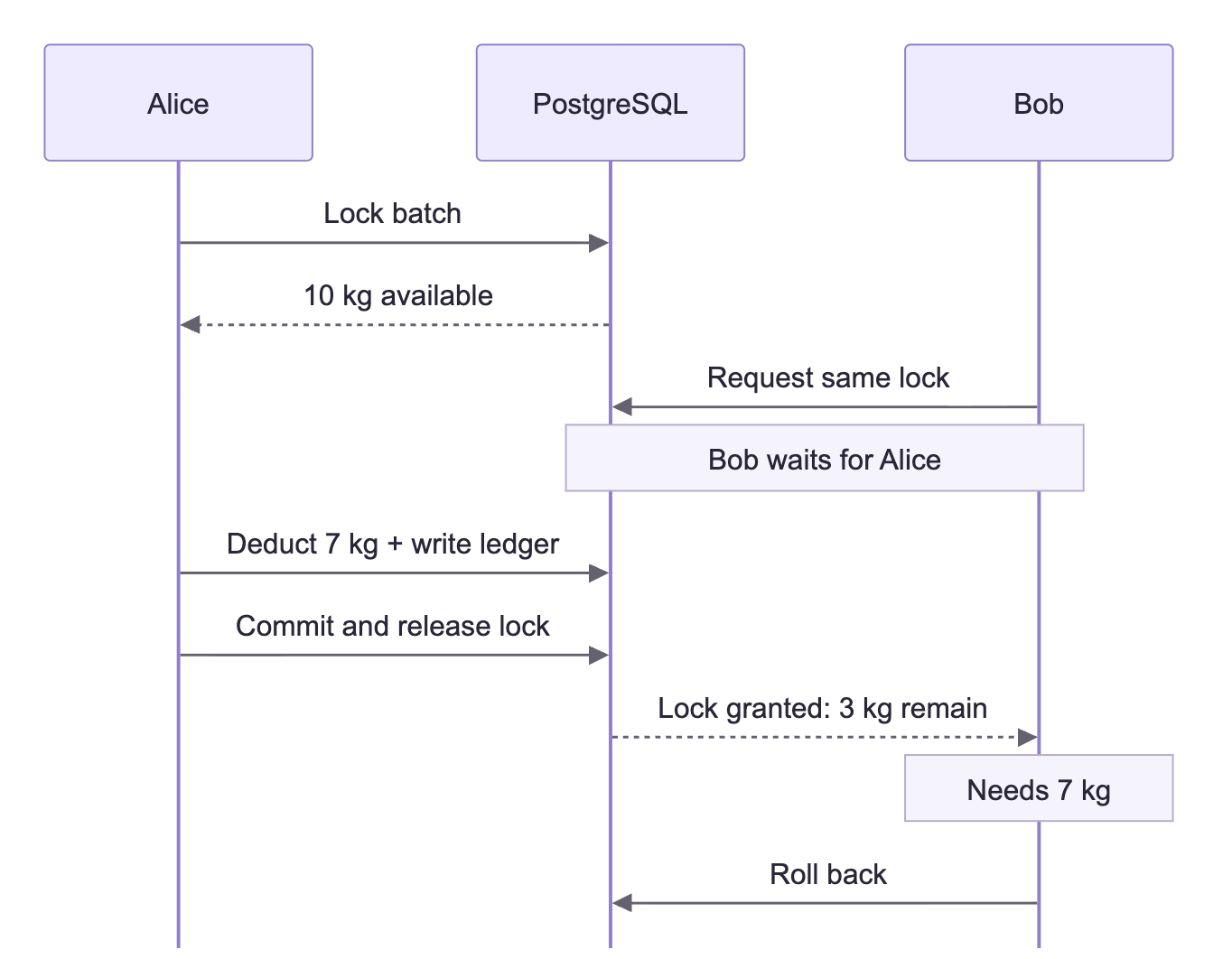
Illustrative PostgreSQL Read Committed scenario: both operations lock the same existing batch before deciding, and that row remains eligible.
FOR UPDATE blocks conflicting writes and locking reads on those rows; it does not block ordinary reads. Locks normally last until transaction end. Stronger isolation can produce serialization errors instead of the illustrated result, and deadlocks require error handling. PostgreSQL explicit locking
ELI5: There is one stock clipboard. Alice finishes correcting it before Bob uses it to promise stock to someone else.
The service owns this coordination; placing files in separate directories does not create the guarantee.
6. The same pattern handles production orders
A production workflow is more demanding than a single deduction. Completing an order consumes input batches, writes stock-movement entries, activates the finished output batch, calculates its expiration, and changes the order to COMPLETED.
These changes belong inside one service-owned transaction. In this example, output stays RESERVED until it is ready, keeping unfinished goods out of ordinary consumption. Its output expiration is the earliest non-null input expiration.
ELI5: Ingredients being assembled into a lunchbox are not a finished lunchbox you can sell yet. The kitchen updates the ingredients, finished meal, and order record together.
State guards belong in the service too. “Complete only an IN_PROGRESS order” depends on current business state, not whether an HTTP body is valid.
7. Three details worth getting right
Exact storage needs exact arithmetic too
PostgreSQL DECIMAL(10,4) provides ten total decimal digits, with four after the decimal point. Its numeric arithmetic is exact where possible, unlike floating-point arithmetic. PostgreSQL numeric types
Using strings at the request boundary and numeric database fields is not enough if quantities are converted to float64 during calculations. Exact arithmetic must be preserved throughout the operation. For inventory arithmetic, use a suitable decimal representation or scaled integers with range checks throughout; formatting a float to four places does not restore lost precision.
Interfaces reduce coupling; they do not remove all of it
Services can depend on small store interfaces, allowing fake implementations in unit tests. Repositories accept a Querier that can be backed by a pool or transaction.
That makes testing easier, but pgx transaction types and PostgreSQL locking semantics still appear in the design. A database replacement may affect services, models, migrations, and tests as well as repositories. Separation limits changes; it does not promise a one-folder migration.
Test policy and database behavior separately
- Pure function tests: Does FEFO allocate the correct quantities?
- Service tests with fakes: Are invalid states rejected and write errors propagated?
- Router tests: Are inputs and domain errors translated into the expected HTTP responses?
- Real PostgreSQL integration tests: Do rollback, queries, constraints, and concurrent locking behave correctly?
A fake transaction can test orchestration, but it cannot prove PostgreSQL concurrency behavior.
8. When is the extra structure worth it?
Layering adds interfaces, wiring, and more files to navigate. A tiny application may need much less ceremony.
FMIS has a stronger reason to pay that cost: several records must agree after every stock movement, and concurrent operators can compete for the same inventory. Clear boundaries make those requirements easier to locate, review, and test.
Use this question when adding a layer: What kind of decision, change, or test does this boundary isolate?
And when deciding where code belongs, ask:
- Does it speak HTTP? Put it at the router or middleware boundary.
- Does it validate the shape of an input? Put it in the schema.
- Does it decide what the business permits or what must happen together? Put it in the service.
- Does it retrieve or persist data? Put it in the repository.
The next time a stock deduction fails, you should be able to follow the request and name the layer responsible—without searching through one enormous handler.
References and further reading
-
Martin Fowler — Service Layer — application boundaries and coordination of business operations.
-
PostgreSQL — Explicit Locking — row locks, waiting, isolation caveats, and deadlocks.
-
PostgreSQL — Numeric Types — decimal precision and exact versus approximate arithmetic.
-
pgx v5 — BeginFunc — callback-driven commit and rollback behavior.
All four figures are adapted from the original Mermaid diagrams in my Notion article. Stock quantities and dates in the worked examples are illustrative.